
When building a business with big ambitions, understanding how venture capitalists evaluate startups gives you a competitive edge. Their decisions shape the future of high-growth companies, and aligning your approach with their expectations helps you go further, faster. Venture capitalists don’t invest in ideas alone. They look at the whole picture: the team, the market, the risks, the potential to scale. If you want to stand out, you need to think as they do.
Key Takeaways
- Venture capitalists look for scalable growth, strong teams, and real.
- Thinking like an investor helps you plan smarter and build with.
- You don’t need a venture capitalist’s funding to benefit from their mindset.
What Venture Capitalists Look For Before They Say Yes
Why do venture capitalists matter so much? Their investments fuel some of the most successful companies around the world. They evaluate thousands of pitches yearly, so they know what separates potential from promise. When they say yes, it usually means they see an opportunity that meets their strict criteria for risk and return.
Growth That Moves the Needle
Venture capitalists are not looking for incremental change. They want to see potential for exponential growth, businesses that could multiply their value by ten or more. For example, Canva scaled from a design tool startup into a global software company used by millions. The ability to grow rapidly, with a scalable product and proven demand, is what gets venture capitalists excited.
A Market That’s Ready to Expand
Even the best product can stall in a small market. Venture capitalists look for startups in industries that are either underserved or growing quickly. A food delivery app in a city with no similar service is one thing. A logistics platform in a billion-dollar market with limited competition is another. The bigger the total addressable market (TAM), the better the chances of a return that justifies the risk.
A Team That Knows the Terrain
More than the pitch deck, venture capitalists trust the people behind the idea. A team with previous exits, deep industry knowledge, or an impressive ability to learn fast can outweigh other gaps. For example, early investors in Airbnb saw resilience and creativity in the founders, who famously sold novelty cereal boxes to stay afloat.
A Clear Competitive Edge
Venture capitalists don’t invest in duplicates. They look for startups that solve problems in ways competitors cannot easily replicate. This could include patented technology, exclusive partnerships, network effects, or a brand that resonates strongly. Think of how Uber’s first-mover advantage and data-driven logistics helped it dominate ride-sharing globally.
Traction That Proves Demand
Early momentum tells a compelling story. Venture capitalists pay attention to signals: Are users signing up? Are customers returning? Do testimonials show deep engagement? If you can point to pilot programs, press coverage, or rising MRR (monthly recurring revenue), it moves the needle from potential to proof.
A Business That Can Scale
Scalability is about growing revenue without growing costs at the same pace. If each new user or transaction improves your margin, you’re in good shape. SaaS platforms like Zoom or Shopify attracted venture capital because they were built to scale globally without major overhead.
Risks That Are Measured
No startup is risk-free. What matters is how well you’ve identified those risks and the strategies you have in place to handle them. Market changes, technical hurdles, and team challenges will come. Venture capitalists favour founders who demonstrate foresight through contingency planning and adaptability.
Numbers That Hold Up
You don’t need to show huge revenue yet, but your numbers should reflect logic and understanding. How do you calculate customer acquisition cost (CAC)? What does your runway look like? Can you justify your valuation? Financial models don’t need to be perfect; they need to be thoughtful, realistic, and transparent.
Vision That Goes the Distance
Finally, venture capitalists look for founders who can lead not just this quarter, but over the next decade. They want to hear about your plans for innovation, leadership development, and evolving your product to meet future needs. This is where breaking barriers and building futures becomes more than a slogan; it’s the mindset that defines sustainable success. Founders who challenge norms, unlock access, and think generationally show that their business isn’t just viable today instead, it’s foundational for tomorrow.
How Students Can Start Thinking Like Venture Capitalists
You don’t need a fund to think like a venture capitalist. By studying what drives smart investment, students sharpen their strategic thinking, financial literacy, and decision-making instincts. Here are practical ways to start building that mindset now:
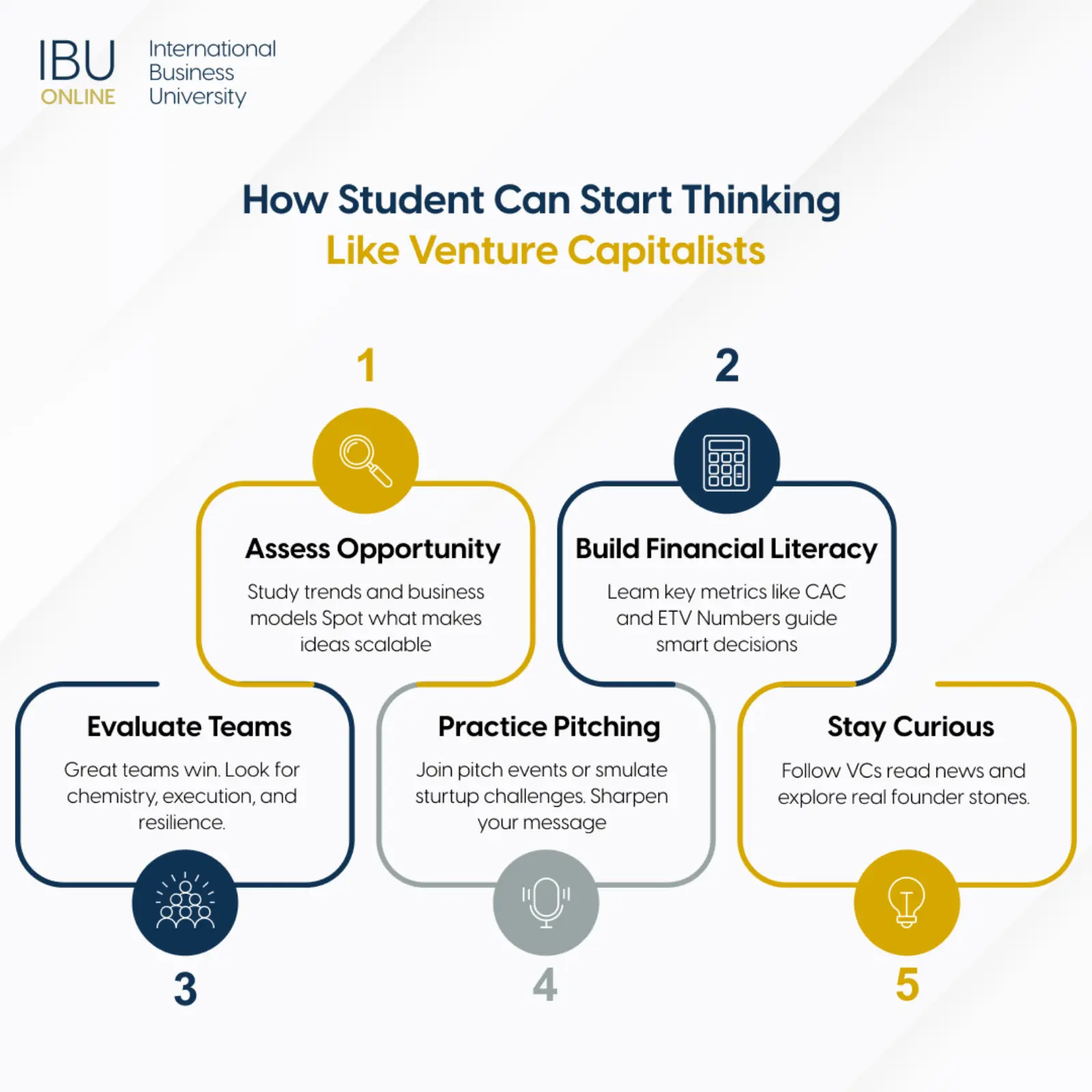
Learn How to Assess Opportunity
Read startup case studies, industry trend reports, and company pitch decks. Analyze why some businesses grow while others stall. Try breaking down companies like Duolingo, Notion, or Shopify. What problem do they solve? Who are their users? Why did they win in crowded spaces? The more examples you explore, the better you get at identifying opportunity.
Build Your Financial Literacy
Understanding numbers makes you a stronger strategist. Learn how to read a profit and loss statement, calculate basic metrics like lifetime value (LTV), or interpret unit economics. Try estimating CAC for a favourite app or mapping its revenue model. Finance tells the story behind every venture decision.
Practice Evaluating Teams
Success rarely happens in isolation. Watch interviews with startup founders. Compare how different teams handle pressure, communicate, and complement each other’s strengths. Practice asking, “Would I invest in this team?” and explain your answer using observations.
Simulate Pitches and Critiques
Join student competitions, clubs, or incubator programs where pitching is part of the process. Rehearse pitches of your own, or critique others. If you’re in a group project, treat it like a startup pitch. What would you change to make the story more convincing? Real-time feedback helps you grow faster.
Stay Curious
Venture capitalists stay informed by reading widely. Follow companies like Andreessen Horowitz, Y Combinator, or Golden Ventures. Subscribe to newsletters like Term Sheet or TechCrunch. Explore podcasts such as “How I Built This.” When curiosity becomes a habit, you start thinking strategically without effort.
How You Can Use VC Thinking to Grow Smarter
Even if you’re not pitching to venture capitalists today, their lens can guide your decisions. Using venture capitalist principles helps you build a resilient, focused, and opportunity-ready business.
Pitching with Precision
When you know what investors value, you can tailor your message. Start with your biggest proof points: market opportunity, product-market fit, and team credibility. Then support those points with data and next steps.
Building Stronger Relationships
Venture capitalists often bring more than funds. They introduce you to advisors, mentors, and future partners. Understanding their language helps you build trust and communicate with more clarity.
Designing a Better Strategy
Aligning with a venture capitalist’s expectations tightens your planning. You start to make decisions with both short-term milestones and long-term growth in mind. That level of clarity benefits your whole team.
Preparing for Sustainable Scaling
You can’t skip steps to scale well. Thinking like a venture capitalist means asking tough questions early: Can your systems handle growth? Do you have the right team to support expansion? The answers shape your path forward.
Contributing to the Bigger Picture
Venture capitalist-backed companies often lead innovation and job creation. When you understand this model, you contribute not just to your startup but to a wider ecosystem of impact. That mindset builds purpose into your growth.
How IBU Builds a Venture Capitalist Mindset
At IBU, you’re not just studying business, you’re being trained to think like both a founder and a funder. This means learning how to spot opportunities, build strategic models, and make decisions with the same level of discipline as a venture capitalist. Through a combination of practical experience, exposure, and rigorous coursework, IBU helps you develop the mindset to scale ventures, evaluate risk, and lead with confidence.
Courses on Tech, Strategy, and Innovation Thinking
You gain more than textbook knowledge. IBU’s curriculum includes modern frameworks like agile planning, lean startup methodology, and product-market fit analysis. For example, in strategy modules, you explore how companies like Stripe and Shopify structured their early-stage growth. In technology-focused courses, you learn how APIs, automation, and data platforms drive operational scale. These lessons are grounded in case studies, helping you connect theory to practice immediately.
Pitch Simulations, Business Labs, and Mentorship
At IBU, classrooms are only the starting point. In business labs and pitch simulations, you work in teams to create investor-ready business models. You deliver elevator pitches, respond to investor-style questions, and adjust based on critical feedback. This process mirrors venture funding scenarios. Mentorship goes beyond casual advice; you’re paired with entrepreneurs, industry leaders, or investors who have launched, scaled, or funded businesses. They help you think through your positioning, unit economics, and go-to-market plans.
Connecting Students to Real Startup Ecosystems
IBU actively integrates students into startup communities. Through partnerships with accelerators, co- working hubs, and early-stage investors, you participate in demo days, hackathons, and founder talks. You get a front-row seat to how venture capitalists evaluate startups in action: the questions they ask, the metrics they expect, and the patterns they watch for. In one semester, you might shadow a founder preparing for seed funding, then debrief with investors afterward to understand their decision process. This type of immersion shortens your learning curve dramatically.
FAQ
What Does A Venture Capitalist Do Exactly?
They invest in startups they believe will deliver high returns. That includes evaluating ideas, mentoring founders, and sometimes joining the board. They also provide ongoing support and strategic guidance to help the business scale. Many serve as connectors to other investors, customers, or advisors.
Do I Need A Venture Capitalist To Grow My Business?
No, not always. Many businesses grow through bootstrapping, loans, or other funding paths. A venture capitalist is just one option. The key is aligning your funding strategy with your growth goals. Some companies thrive without ever raising outside capital.
What’s The Typical Return A Venture Capitalist Expects?
They usually aim for at least 10x their investment within several years. That’s why they are highly selective. They expect a few home runs to balance the risk of many startups that may not succeed. These return expectations influence how they assess every opportunity.
Strengthening Strategy by Having a Venture Capitalist’s Perspective
Venture capital isn’t the only route to success. Even so, thinking like a venture capitalist gives you a clearer roadmap. You learn to focus on value, build systems that last, and communicate your story with confidence.
If you’re aiming to lead in today’s economy, venture capitalist thinking helps you set smarter goals, attract better partners, and plan for a future that scales. Whether you’re raising capital or not, these insights give you an edge worth developing.