
Thinking like a founder means spotting gaps where others see inconvenience, and deciding like a venture capitalist means making bold bets that can change your future. Together, this venture mindset gives you a way to operate in uncertainty with clarity, speed, and purpose. It’s not about titles, funding, or flashy headlines. It’s about how you choose to think and act when the path isn’t clear. This mindset helps you move fast, learn from feedback, and build value where others hesitate, the exact edge you need in today’s fast-moving world.
Key takeaways:
- A venture mindset isn’t about money or titles; it’s about how you think, act fast, and create value in uncertain environments.
- Founders, operators, and VCs share this mindset by focusing on experimentation, small bets, and long-term outcomes instead of perfection or safety.
- You can build this mindset through daily habits like testing ideas, challenging assumptions, and learning from feedback and no startup required.
What Is a Venture Mindset, Really?
Most people hear the word “venture” and think of money, venture capital, big exits, and billion-dollar startups. The venture mindset, however, isn’t about money. It’s about how you think when you’re trying to build something new in an uncertain, fast-moving world. A founder, student, or future operator who develops this mindset helps you navigate ambiguity with clarity, energy, and drive.
The venture mindset means seeing the world through a lens of possibility, not just stability. It’s not a job title or a personality type; it’s a way of thinking that prioritizes speed, experimentation, and long-term value creation over short-term safety. And as the world changes faster than ever, this mindset is becoming less of a luxury and more of a necessity.
It’s Not About Money, It’s About Mental Models
A venture mindset isn’t about chasing funding rounds or reading TechCrunch headlines. It’s about how you think when the path isn’t obvious. At its core, it’s a collection of mental models, simple yet powerful ways of understanding the world that guide how you solve problems, make decisions, and pursue value.
These models give you a structured way to operate in messy, fast-changing environments where traditional rules don’t apply.
Instead of waiting for perfect clarity, you rely on principles like tests before you scale, look for leading indicators, or solve for why, not just how. These aren’t just startup slogans; they’re thinking tools that help you act with purpose, not panic. The venture mindset teaches you to ask sharper questions, challenge lazy defaults, and focus not on what’s safe but on what’s possible.
This mindset puts more weight on learning than knowing. You don’t need to have all the answers upfront; what matters is having a system for uncovering them. That system includes rapid experimentation, honest feedback loops, and constant reflection. It’s how you build confidence in uncertainty, not through perfection, rather through process.
You become someone who’s always improving their map of the world, someone who doesn’t fear being wrong because being wrong is part of getting better. That’s the deeper advantage of the venture mindset: it trains you not just to succeed but to adapt, evolve, and build again, smarter each time.
A Way of Thinking Shared by Founders, Operators, and Investors
What do successful founders, startup operators, and top-tier investors have in common? It’s not background or education, it’s how they think. They share a core approach: act fast, stay adaptive, and bet on what others overlook.
You’ll see the same mindset in the people building the product, running the company, or choosing which ventures to back. They’re different roles with the same mental wiring: solving for value, not just safety.
Why It’s More Relevant Now Than Ever
The world isn’t just changing, it’s accelerating. AI is transforming industries, the job market is shifting, and new tools emerge every week. In this environment, waiting for certainty is a losing move.
A venture mindset helps you stay relevant by making you adaptable. You’re not just reacting to change, you’re prepared to shape it. That’s why it’s becoming the edge that students and young professionals can’t afford to ignore.
5 Core Traits That Define a Venture Mindset
A venture mindset isn’t vague inspiration; it shows up in specific ways of thinking and acting. These five traits show up consistently in people who lead with a venture-driven approach.
- Bias for Action, Not Just Analysis: People with a venture mindset don’t get stuck in research mode. They act, test, and refine instead of waiting for perfect information.
- Clarity Under Uncertainty: Even when the path isn’t clear, they find focus. They use simple principles to make decisions and move forward through the fog.
- Obsession with Value Creation: They don’t just want to make things; they want to make things that matter. Every effort is measured by the impact it creates.
- High Ownership Thinking: They act like owners, not renters. That means taking responsibility, driving outcomes, and treating every problem like it’s theirs to solve.
- Comfort with Risk and Imperfection: They don’t fear failure; they use it. Instead of chasing flawless plans, they build messy, fast, and real.
Think Like a Founder: Spot Problems, Build Fast, Iterate Smarter
Founders see the world differently. Where most people see a hassle, they see an opening. They don’t wait for someone else to fix the problem; they build the solution themselves.
A venture mindset trains you to think like a founder, even if you’re not one yet. It’s about speed, experimentation, and constant improvement, not overplanning or overthinking.
- Why Founders See Gaps Where Others See Inconvenience: Founders are trained to notice friction and ask, “Could this be better?” Instead of accepting annoying systems or broken tools, they see a chance to invent something new.
- Building > Planning: Speed as a Competitive Advantage. Founders move quickly, not recklessly, but rather with decisiveness. In fast-moving markets, waiting can cost more than failing.
- Iteration and Feedback Over Perfection: Instead of aiming for perfect launches, they test early and learn fast. Feedback is their compass, not a final exam.
Decide Like a VC: Think in Bets, Outcomes, and Portfolios
Venture capitalists don’t just look for great ideas; they look for asymmetric bets: small risks with massive upside. Adopting this lens helps you make smarter decisions in school, work, and life.
Thinking like a VC means zooming out. You’re not just chasing the next task; you’re building a portfolio of bets across time, each with potential to shape your future.
- The Power Law Mentality: One Bet Changes Everything. VCs know that most startups won’t win, yet one big win can pay for all the losses. Similarly, one bold decision can define your career.
- Looking for Signals, Not Just Credentials: Great investors don’t chase resumes; they look for insight, resilience, and a unique edge. Apply the same lens to your own choices and collaborators.
- Saying “No” 100 Times to Say “Yes” Once (and Why That’s OK): Venture thinking means being selective. Saying “no” more often keeps you focused on the things that truly matter.
Venture Mindset vs Corporate Mindset
It’s not about startups vs big companies, it’s about how you approach problems and possibilities. These two mindsets lead to very different decisions.
If the corporate mindset optimizes for stability, the venture mindset optimizes for growth. Knowing the difference helps you choose how you want to operate.
- Predictability vs Possibility: Corporate thinking often favours known paths. Venture thinking embraces the unknown to chase greater upside.
- Job Security vs Optionality: One values a steady role; the other values building leverage and learning fast. Both have trade-offs; you choose your risk.
- Playing It Safe vs Playing to Win: The corporate path avoids mistakes. The venture path accepts them as part of reaching something new.
How to Build a Venture Mindset in Everyday Life
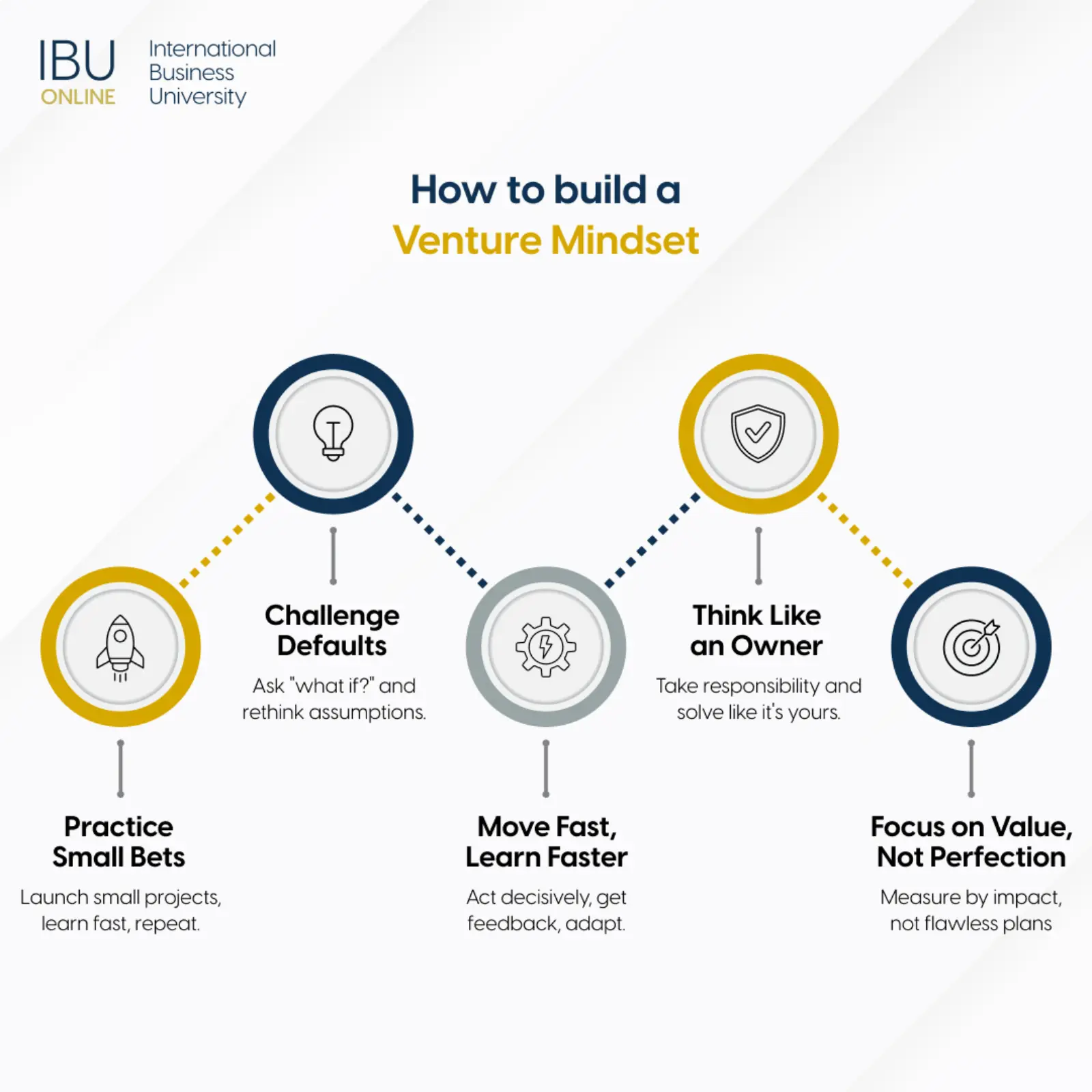
You don’t need to start a company to start thinking like a founder or investor. You can build a venture mindset through daily habits and deliberate thinking.
The key is practicing small bets and shifting how you see problems. These actions build your decision-making muscle, one move at a time.
- Practice Small Bets: Launch, Learn, Repeat: Try small projects with limited risk. A blog, a prototype, a side hustle, each one sharpens your instincts.
- Challenge Default Thinking: “What If We Flipped It?”: Don’t accept how things are. Ask what would happen if you reversed the rules or redesigned the system.
- Study Startup Cases, Write Memos, Debate Bold Ideas: Learning how others think gives you models to work with. Turn case studies into conversations and write your take.
How IBU Helps Students Build a Venture Mindset
At IBU, we don’t just teach business, we build venture mindsets. Our programs are designed to help you think and act like a founder, operator, or investor before you even graduate.
This is where you start breaking barriers and building futures; your own, and those you’ll lead.
- Hands-On Learning in Real Startup Scenarios: From ideation to pitch decks, you’ll tackle real-world problems in simulated venture environments.
- Innovation-Focused Curriculum with Industry Relevance: Courses are designed around what today’s founders and investors actually use, not just theory.
- Coaching, Pitching, and Exposure to Venture Ecosystems: You’ll pitch ideas, get feedback from real investors, and learn how the startup world really works.
FAQ
What if I’m Not Planning to Start a Business?
That’s perfectly fine. The venture mindset isn’t reserved for startup founders; it’s a way of thinking that applies in companies, freelance work, or even when you’re still figuring things out. It sharpens how you approach problems, make decisions, and create value in any setting. In fact, some of the most impactful operators and leaders in startups never start their own ventures; they simply think like those who do. You can bring this mindset to product teams, nonprofits, classrooms, or your own career development.
Isn’t This Just “Entrepreneurship” Rebranded?
Not quite. Entrepreneurship is an outcome, a role or a path. A venture mindset is the operating system underneath it. It’s about how you think under pressure, how you evaluate opportunities, and how you move forward without certainty. You can be entrepreneurial without having a venture mindset (often with mixed results), and you can have a venture mindset even if you’re not starting anything right now. The key difference is that the mindset is durable; it travels with you across jobs, industries, and stages of life.
Can I Develop This Mindset Without Taking Big Risks?
Yes, and in fact, that’s the best place to start. You don’t need to quit your job or raise capital to build this way of thinking. Start by making small bets, a side project, a community initiative, or a bold idea pitched in class. These are low-risk, high-learning opportunities that train your eye for value, your comfort with feedback, and your tolerance for ambiguity. Like a muscle, the mindset strengthens through repetition, not through one dramatic leap. The goal isn’t to gamble, it’s to build conviction through practice.
Final Thoughts: Developing the Venture Mindset That Wins
Building, leading, or investing starts with more than just a plan; it starts with the venture mindset. This mindset acts as a lens that helps you navigate uncertainty with clarity and intent, seeing gaps and hidden signals where others hesitate. It’s not tied to a title or funding, but to how you choose to think today. Each small risk, bold question, and willingness to lean into discomfort sharpens your edge and becomes your competitive advantage in a world where stability can’t be counted on. Even if you’re coding, designing, pitching, or reinventing, success comes from developing the mindset to adapt, learn, and build what’s next.